
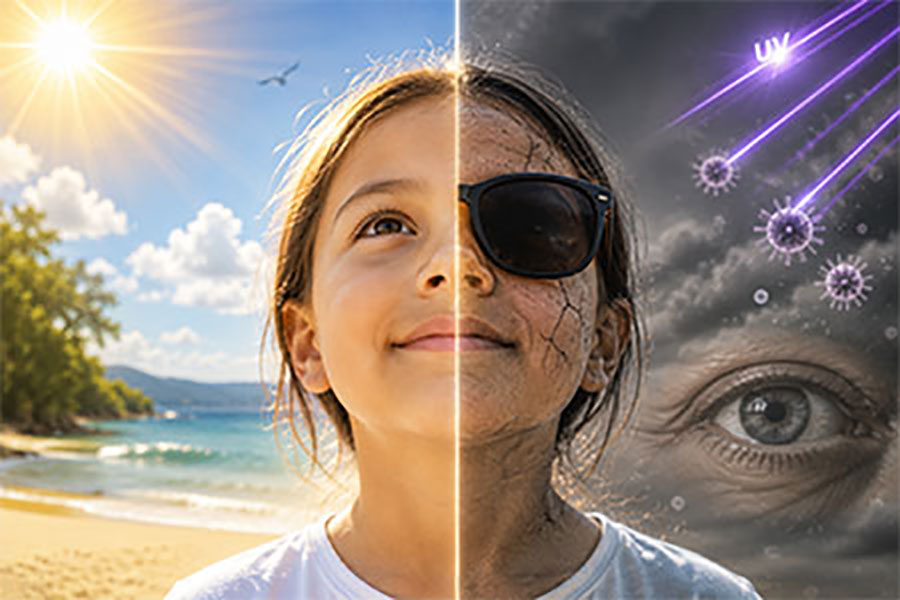
Many things in life, sunlight is neither all good nor all bad. It may brighten our day but comes with the invisible threat of ultraviolet (UV) rays that have harmful effects on our eyes. The healthy effects of exposure to sunlight include regulating our natural wake-sleep cycles, triggering the production of the essential nutrient vitamin D, and playing a protective role against the development of shortsightedness in children.
Over time, too much UV exposure can have a cumulative effect and has been linked to the development of long-term eye conditions such as cataracts. While these conditions typically appear later in life, the exposure that contributes to them often begins in childhood. So, while time outdoors is essential for healthy visual development, UV exposure needs to be managed. This creates a delicate balance.
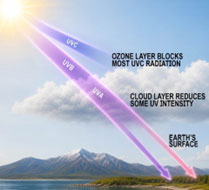
Our main natural source of ultraviolet radiation is the sun. While sunlight can be seen, ultraviolet light is not visible to the human eye but contains more energy than visible light. It can penetrate light cloud cover, so the eyes are exposed to it even on cool cloudy days. UV exposure increases significantly around reflective surfaces such as water, sand, and even concrete.
At the beach, in a swimming pool, or even on a school sports field we may be getting UV light not only from above but also reflected from below. Some artificial sources of UV light are tanning booths, fluorescent lights and certain types of lasers. UV radiation, whether from natural sunlight or indoor artificial rays, can damage the eye’s surface tissues as well as the cornea and lens.
Children’s eyes are naturally more vulnerable to ultraviolet rays. The clear lens inside a child’s eye is more transparent, allowing a greater proportion of UV rays to pass through to the retina. As we age, this lens gradually yellows and acts as a better filter, but in childhood, that natural protection is not fully developed yet. A child’s eye is letting in more “invisible sunlight” at exactly the stage when their visual system is still developing.
Sunglasses are more than a fashion statement, more than a summer accessory. They are essential eye wear in all seasons of the year. They have been called the “secret superpower” which shields our eyes from the invisible threat of ultraviolet rays. A good pair of sunglasses blocks harmful UV rays and reduces glare, making it easier and more comfortable to see, especially on bright days.
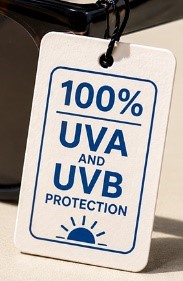
When buying sunglasses, don’t settle for partial protection.
Only sunglasses with 100% UV protection provide the safety you need.
Look for a label that promises 100% UV protection from all types of UV light, and blocks both and UV-A and UV-B light.
Although sunglasses may not continue to protect your eyes from UV light over time, your optometrist will be able to test the level of protection.
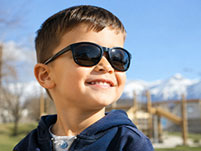
Large lenses generally mean more coverage, and wraparound-style sunglasses offer even more protection by preventing UV rays from entering along the sides. It is a common belief that the darker the lenses, the better the protection.
In fact, dark lenses without UV protection can be worse than not wearing sunglasses at all. While the dark tint may reduce brightness, it tends to cause the pupils to dilate, letting in more harmful rays instead of blocking them.
Sunglasses with coloured lenses are generally more a reflection of personal style than eye safety and won’t necessarily block out more UV rays than other lenses. Mirror finishes or metallic coatings may reduce the amount of light entering the eyes, but they won’t fully protect them from UV light.
Impact protection is advisable for children or for sport. While no lens is truly unbreakable, plastic lenses are less likely than glass lenses to shatter. Most nonprescription lenses are made from some type of plastic. Polycarbonate sunglasses can withstand stronger impacts than regular plastic lenses but tend to scratch easily without a scratch-resistant coating.
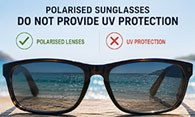
Polarised lenses reduce the glare bouncing off reflective surfaces such as water or roads, but polarisation itself does not provide UV protection. Some polarised lenses come with a UV-blocking finish. Check the label of your polarised sunglasses to make sure they provide maximum UV protection.
Sunglasses can’t protect your eyes from all UV hazards or from certain light sources, such as tanning beds and welding. Special lens filters are available for these situations. They also do not protect the eyes if you stare directly at the sun. Never look directly at the sun. Doing so at any time, including during an eclipse, can damage the eye’s retina.
Sunglasses don’t have to be expensive to be safe and effective! Cheaper sunglasses labelled as 100% UV-blocking are a better choice than designer sunglasses with no protection.
UV light may be invisible, but its effects are not. By understanding how it interacts with young eyes, we can take simple, effective steps to protect children’s vision while still encouraging them to enjoy the great outdoors.