
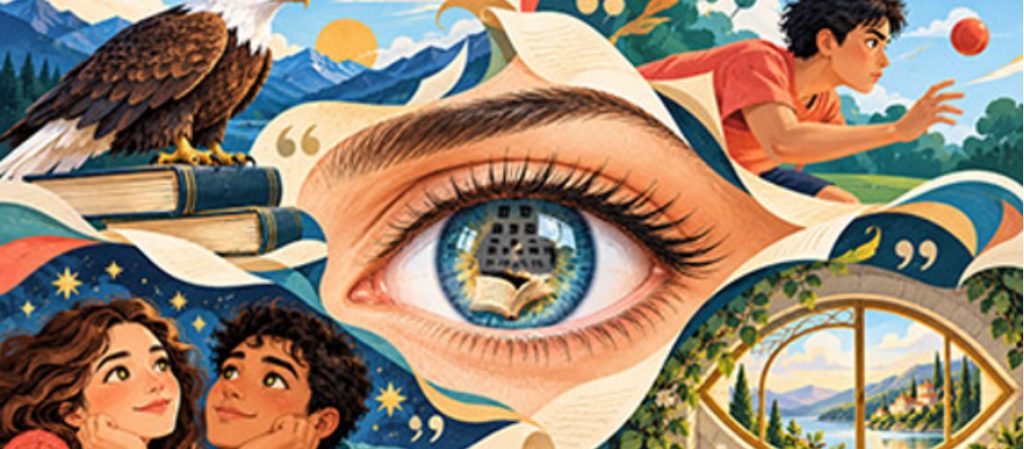
Eye idioms are an integral part of the English language. We use them every day “without batting an eye” or giving them a second thought, to convey a range of emotions, attitudes, actions and situations in a vivid and imaginative manner. They infuse language with colour and personality, illustrating its diversity and richness, and going beyond the literal meanings of words to uncover their figurative nature. Many idioms have evolved over time, but the essence remains connected to visual perception or observation, emphasising the significance of sight and perception in human communication.
Famous eye idioms date back to historical contexts and cultural references, originating from ancient legal codes, old translations of the Bible and literature that spans the centuries. For example, the expression “an eye for an eye” originates from the Old Testament, symbolising the principle of retributive justice, which states that a punishment should match the crime in fairness.

In literature and media, eye idioms enhance the narrative by creating vivid imagery or expressing characters’ attitudes. Often used in detective stories to illustrate an investigative trait, a character described as having “an eagle eye” is immediately understood to be observant and missing nothing. Or, when a character is said to “look daggers at” another, it communicates intense anger or disapproval. Across his plays and poetry, Shakespeare uses “eyes” as a symbol for truth, perception, and emotional inner states, where vision represents power, love, and deception.

Many idioms about eyes reflect observation and attention, ranging from acute awareness to selective attention or deliberate disregard. The expression “to turn a blind eye” has an interesting story attached to it. During the Battle of Copenhagen in 1801, British naval commander Horatio Nelson, who had lost the sight in one eye, was reportedly signalled to withdraw from the battle. Nelson disagreed with the order and is said to have raised his telescope to his blind eye and remarked that he couldn’t see the signal. This helped popularise “turning a blind eye” as ignoring or pretending not to notice something you would rather not acknowledge.
On the other hand, “being all eyes and ears” means paying keen attention, while “keeping an eye on the ball” or keeping “the eyes glued” denotes being completely focused on the task at hand. “Keep your eyes peeled” requires you to be particularly alert and observant, ready to spot whatever you’re looking for or be prepared for dangers or opportunities.
Eye idioms are frequently used to convey feelings of affection, beauty, grief and mutual understanding in relationships. A couple in love is described as “starry-eyed” and are unable to “take their eyes off each other”. To express intense sorrow or distress, we “cry our eyes out”.

The expression “the apple of one’s eye” dates back centuries to a time when the pupil of the eye was thought to be a small, round, solid object, similar to a tiny apple, and was regarded as something precious that needed to be protected. There is no universal definition of beauty because what one person finds beautiful others may not: “beauty is in the eye of the beholder”.
When we are particularly pleased to see someone, either during troubled times or after a long, difficult journey, they are “a sight for sore eyes”, a term first used in 1738 by author Jonathan Swift. Deception in a relationship? Things not quite what they appear to be? There may be “more than meets the eye”, or perhaps the people involved “don’t see eye to eye”?

Children are warned not to misbehave because their mothers have “eyes in the back of their head” and always know what they are up to! If they have done something wrong, they should “look their mother in the eye” and be honest. “All eyes are on” someone who is “in the public eye”, indicating that he is in a position where his actions can be observed, and he should be careful what he says or does. It may be more comfortable to avoid scrutiny by being “out of the public eye”. To look at something with great enjoyment is to “feast your eyes”. However, continuing the theme of a “feast”, if “your eyes are bigger than your stomach”, you may want more food than you can eat.
The eyes being the “windows of the soul” is an image often attributed to William Shakespeare or Leonardo da Vinci, but its true root is an old proverb based on the idea that a person’s true nature and feelings show through their gaze. Your optometrist may change that a little, referring to your eyes as “the window to your health”. It is only in a comprehensive eye examination that the blood vessels of the body can be easily seen and may reveal vision or health conditions in their early stages before symptoms have emerged. So, “keep an eye on” your visual and general health by scheduling regular eye examinations.