
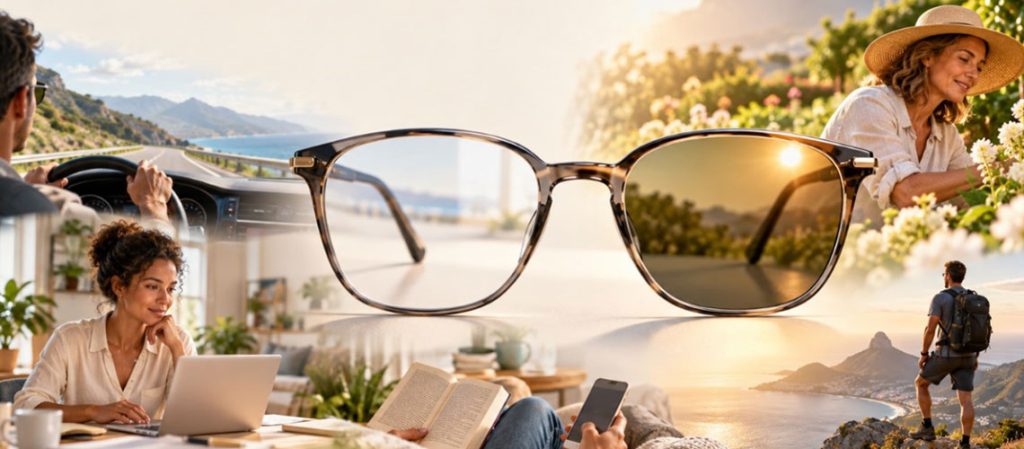
Think about your average day. You drive. You work at a computer. You read. You use your phone. You spend time outdoors. Perhaps you play sport, garden or travel frequently. Choosing glasses to cope with your day-to-day lifestyle can be quite overwhelming. Would you like the standard model? Something that changes automatically according to conditions? A model designed especially for driving? Perhaps something for the office? And would you like some additional protection added? Welcome to the complex and sophisticated world of spectacle lenses.
ONE PAIR, SEVERAL DISTANCES
Various types of lenses are designed for different distances.
The most basic of these are single vision lenses which have one prescription across the entire lens to correct either near or distance vision.

Bifocal lenses contain two distinct optical powers to accommodate clear vision for both near and far. Typically, the top of the lens contains the distance vision prescription, while the bottom of the lens contains the prescription for near vision.

Trifocals contain areas for distance, intermediate and near vision, with the intermediate segment being helpful for viewing objects at arm’s length, such as a computer, or car dashboard.

Progressive or multifocal lenses contain multiple lens powers for vision clarity with a gradual blending of the powers rather than a visible bisecting line.
If much of your day is spent at your desk looking at your computer, occupational or office lenses are designed specifically for near and intermediate working distances, and for tasks such as moving between paperwork and the computer. Reading glasses are helpful for presbyopia, the natural aging condition, and are used when needed to see close objects and small print more clearly.
DIFFERENT MATERIALS
Lenses can be made from various materials such as glass, plastic, polycarbonate and resin. The material your lenses are made of affects their thickness and weight, as well as the comfort, visual clarity, durability, and overall experience of wearing your glasses. It is based on your lifestyle, vision needs, aesthetics, and comfort.
CHAMELEONS OF THE SPECTACLE WORLD

Photochromic or transition lenses automatically adjust to changing light conditions. Clear indoors, they darken when exposed to sunlight and ultraviolet radiation and gradually become clear again when you return indoors. For those who wear glasses, they provide convenience and protection without the need to switch between glasses and sunglasses.
Because modern car windscreens block much of the UV light that traditionally activates photochromic lenses, not all photochromic lenses become as dark inside a car as they do outdoors.
AND THEN THERE ARE THE EXTRAS
Lens coatings are optional upgrades that significantly improve the functionality and durability of your prescription lenses. They are microscopic layers added to the lenses which don’t change the prescription but enhance your visual experience by reducing glare, blocking UV rays, and protecting your lenses from the damage which occurs with daily wear.
Anti-reflective lenses eliminate glare and reflections from screens, headlights, and overhead lighting, reducing eye strain and improving visual clarity especially in low light, such as when driving at night. They are recommended for both single vision and multifocal lenses.

Polarised lenses block intense horizontal glare from flat surfaces, improving visibility and reducing eye strain. They minimise harsh glare from water, roads, and car hoods, enhance colour contrast and visual clarity, and reduce eye fatigue and squinting during outdoor activities. Many polarised lenses come with UV protection built in, but it’s always worth confirming this when choosing your prescription lenses as UV coatings are essential for anyone who spends time outdoors. Polarised lenses can make it difficult to read LED screens.
Exposure to ultraviolet radiation from the sun over time can lead to conditions such as cataracts and macular degeneration. The UV coating blocks harmful ultraviolet rays from reaching your eyes, providing essential protection against UV light and reducing the risk of UV-related eye damage.
Even the most careful eyewear users occasionally drop or mishandle their glasses and can’t completely avoid daily wear and tear. Scratch-resistant lenses minimise surface damage, keeping your vision clear and extending the life of the glasses, helping to avoid the need for costly replacement of scratched lenses. While no lens coating can make a lens entirely scratch-proof, scratch-resistant lenses significantly improve resistance to daily wear and tear.
As well as making it easier to wipe lenses clean, an oleophobic or smudge-resistant coating repels oils, fingerprints, and dust, all of which can interfere with clarity of vision.
WHAT DO YOU NEED YOUR GLASSES TO DO?
Instead of asking what glasses we need to help us see better, we should be asking what else we need our glasses to do, taking into account factors such as lifestyle, daily activities, budget and personal style preferences. Because our glasses can do considerably more than we might think!